

Corey Day Resilience became a practical racing lesson on April 25, 2026, when the 20-year-old earned his first NASCAR O’Reilly Auto Parts Series victory in his 22nd career start at the Ag-Pro 300 at Talladega Superspeedway. He led only the final lap, and the yellow flag came out after a late-race incident, freezing the field with Day in front, according to NASCAR’s Talladega recap. For racers and families watching from the grassroots level, the win offered more than a result. It showed how calm choices, patience, and trust in preparation can carry a driver through a race that rarely gives anyone a clean path.
That is why Day’s spring 2026 wins still matter for rider lifestyle conversations months later, on October 20, 2026. The point is not to turn one finish into a myth. The value is in studying what was confirmed: his Talladega patience, his Dover late-race execution, and his steady run of top-10 results through June 27, 2026. Those details give racers, crews, and families useful habits to discuss before their own pressure moments arrive.
What Corey Day Resilience Shows Under Pressure
Corey Day Resilience At Talladega
At Talladega, Day started third, finished the first two stages in 15th, and worked back into position in the final stage. Hendrick Motorsports reported those race details in its April 25, 2026, recap, noting that Day earned his first career O’Reilly Series victory at the track in its team report. That pattern matters. A driver who starts near the front can feel pressure to force the issue early. Day’s result showed the value of accepting where the race placed him, staying in the draft, and being ready when the final opportunity came.
Superspeedway racing can punish impatience. The research notes from the event describe late chaos: cars going sideways behind Day, a block attempt ahead, and a crash in turns 3 and 4. Day stayed clear enough to be scored first when the yellow came out. That does not mean luck had no place in the finish; racing always includes factors a driver cannot control. What can be studied is the part inside the driver’s reach: holding a steady line, staying alert, and not letting earlier stage positions decide the tone of the final laps.
Dover Lessons Under Late Pressure
On May 16, 2026, Day earned his second O’Reilly Series win at Dover Motor Speedway in the BetRivers 200. It was his first start at that track. The research notes state that Justin Allgaier led a race-high 71 of 200 laps, while Day passed him with four laps remaining and won by 0.461 seconds. Those facts point to a different kind of pressure than Talladega. Dover required him to stay close to a veteran who had controlled much of the race, wait for the right moment, and then protect a narrow lead to the line.
For local racers, that is a useful comparison. Talladega asked for restraint in a pack. Dover asked for patience in a chase. In both cases, the mental skill was not loud or dramatic. It was the ability to keep making clear decisions when the race was nearly over and the margin for error had become small.
Race-Day Habits Racers Can Practice
Build A Calm Pre-Race Routine
Corey Day Resilience is useful because it can be translated into habits that do not require a national-series budget. Before a race, a driver can set a short routine that separates preparation from panic. That might include reviewing the first-lap plan, naming two passing zones, confirming radio expectations with the crew, and choosing one reset phrase to use after a mistake. The goal is not to erase nerves. The goal is to give the mind a familiar track to follow when the body feels the pressure of competition.
Day has publicly described an approach based on staying calm rather than overthinking, focusing when the stakes rise, and leaning on a relaxed California mindset shaped by sprint-car roots and family racing background. Racers at any level can adapt that idea by asking a simple question before strapping in: what helps me stay clear without going flat? Some drivers need quiet. Others need one short check-in with a parent, spouse, mechanic, or teammate. The habit should fit the person, not copy someone else’s personality.
Review The Race In Manageable Pieces
Pressure often grows when a driver treats the whole race as one giant test. Breaking it into pieces can help. Day’s Talladega result is a strong example because the first two stages did not decide the outcome. For amateur racers, that lesson can shape the post-race review. Instead of asking only whether the finish was good or bad, talk through the start, restarts, traffic, tire feel, communication, and the final decision point.
- Name the controllable: line choice, restart focus, braking markers, communication, and recovery after a mistake.
- Separate result from process: a podium can still include poor choices, and a tough finish can still include growth.
- Use one lesson at a time: choose a single habit for the next race rather than trying to fix everything at once.
- Protect non-racing time: families and crews need moments away from setup talk, travel stress, and performance review.
These habits also protect relationships. Racing families often share money, time, travel, and emotion. A calm debrief keeps the driver from feeling judged and helps supporters feel included without taking over the athlete’s role.
Community Support Behind Calm Decisions
Why Team Trust Matters
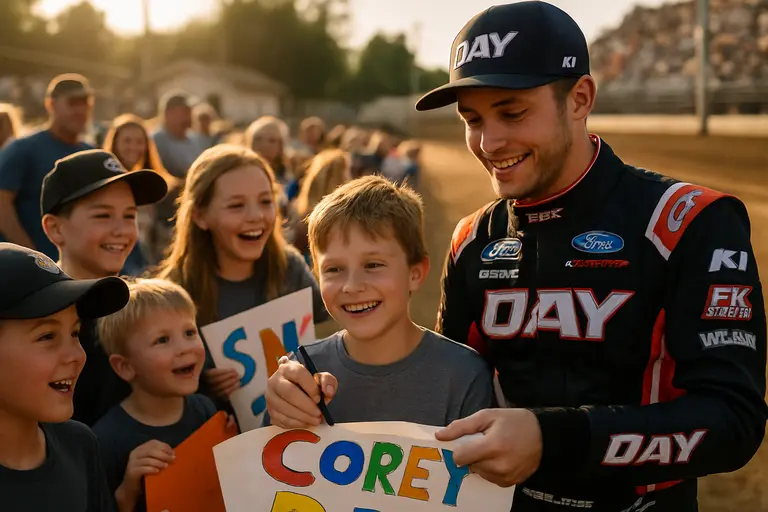
No driver builds composure alone. The research notes point to Day’s family racing background and his sprint-car roots as part of the mindset he has described publicly. That does not mean family support guarantees wins. It means the people around a racer can create the conditions where clear thinking is easier. A crew that communicates plainly, a parent who knows when to encourage rather than instruct, and a sponsor who respects the learning curve all contribute to the same goal: keeping the driver grounded.
That sense of support is also part of why Day’s development has drawn interest beyond the box score. For readers who want more context on how team structure can shape a young racer’s growth, our related piece on Corey Day development looks at support, preparation, and the shift from dirt experience to stock-car learning. The key takeaway for community racers is practical: surround the driver with people who lower noise, not people who add panic.
What Local Pits Can Take From It
Corey Day Resilience also speaks to the everyday rhythm of the racing lifestyle. Most teams are not arriving with large staffs. They are loading trailers after work, balancing school or family schedules, and solving small problems with limited time. That makes mental preparation a community task. The driver needs focus, but the group around the driver sets the tone long before the green flag.
A simple crew agreement can help. Decide who talks to the driver before qualifying, who handles tools, who manages food and hydration, and who gives feedback after the race. If everyone has a role, the driver faces fewer last-minute decisions. For broader local resources and related community connections, explore Efficient Directory to find organizations and services within the same network of practical support.
Corey Day Resilience For Local Racers
The lesson in Corey Day Resilience is not that pressure disappears. His April 25, 2026, Talladega win came after mid-race patience and a final-lap move in a chaotic finish. His May 16, 2026, Dover win came after tracking a veteran leader and making the decisive pass with four laps left. Through Sonoma on June 27, 2026, the research notes state that he had 14 top-10 finishes across 19 races, tied for the most in the series at that point. That kind of consistency is a reminder that mental strength is built through repeatable choices, not one dramatic moment.
For younger racers, Corey Day Resilience can be discussed at the kitchen table, in the trailer, or during the ride home. Ask what went well under pressure. Ask what felt rushed. Ask which voice on the radio helped and which comments can wait until later. Those conversations build trust, and trust helps racers return to the track with a clearer mind. Day’s 2026 wins are already part of the record. The practical value now is how racers and supporters use those examples to build calmer, steadier race weekends of their own.