

Dirt racing gear has become a bigger part of race-day success at Texas Motor Speedway because the 2026 dirt program gave teams more fixed dates, more class variety, and more reasons to prepare around technical rules instead of guesswork. Texas Motor Speedway announced six dirt race weekends and 15 race days from March through November 2026, with classes including winged sprint cars, modifieds, and factory stocks, according to the track’s announced 2026 dirt schedule.
For racers and family crews, that kind of calendar affects more than travel plans. It changes how helmets are checked, how fire suits are stored, how tires are logged, and how setup notes are built from one appearance to the next. Texas Motor Speedway’s 2026 dirt programming also included the Astound Business Solutions Texas World Dirt Track Championship on October 2-3, 2026. As of October 24, 2026, that event has already taken place, so the useful lesson now is retrospective: the teams that treated rules and equipment as part of preparation had a clearer path through inspection and race-day demands.
Why Dirt Racing Gear Now Starts With The Schedule
Six Race Weekends Change The Prep Rhythm
A spread-out schedule can help teams build habits instead of rushing through the same checklist on every race morning. The 2026 Texas Motor Speedway dirt season ran across multiple months, which gave racers opportunities to inspect belts, gloves, shoes, and helmets between events. That matters because the research notes point to safety requirements that apply not only during races, but also whenever the car is on track for hot laps, warm-ups, or packing.
From a gear-maintenance view, that means a driver cannot treat protective equipment as something saved for the feature. If the car rolls onto the surface, the driver needs the required equipment ready. A suit that is still damp from cleaning, gloves left in a trailer compartment, or a helmet that has not been presented for inspection can slow the whole crew. The schedule makes preparation a recurring discipline, not a one-day scramble.
Community Crews Carry The Workload
Most grassroots dirt teams are built around family, friends, and local supporters. One person may handle tire pressure notes, another may help with belts, and another may load the safety bag before leaving home. That shared work can reduce stress for the driver and build a better race-day rhythm. For families still setting priorities, our related piece on new racer gear priorities fits the same safety-first mindset.
Community also matters beyond one trailer. A steady program at a major venue gives local racers more chances to compare preparation habits, learn from inspection procedures, and support newer teams without relying on rumors. For comprehensive sports updates including motorsports, Sports Wire News provides related coverage within the same network.
Dirt Racing Gear Checks For Standardized Rules
Dirt Racing Gear And Inspection Readiness
The 2025 Texas Motor Speedway Limited Modified rules cited in the research required drivers to use a certified helmet marked SA2010 or SA2015, a one- or two-piece flame-retardant fire suit, fire-resistant gloves and shoes, and a five- or more-point safety harness. The same research notes say helmets had to be presented at inspection, and non-certified helmets were not allowed.
For any racer, that creates a simple but serious lesson: keep safety equipment inspection-ready before the trailer door closes. A helmet sticker should be readable. Gloves and shoes should be packed together. Belts should be checked for routing and mounting before the car reaches the track. A dirt racing gear bag is not just storage; it is part of the team’s compliance plan.
Safety Equipment Is Not A Race-Only Task
The research notes also say the required safety gear applied whenever the car was on track, including hot laps, warm-ups, and packing. That requirement changes the mental routine. A driver who suits up only for the main event risks being unprepared for earlier track activity. Crews should treat every on-surface session as an active safety session.
Fire protection also deserves steady attention. The research notes identify fire suits, shoes, and gloves as mandatory, while built-in fire-extinguishing equipment was recommended. Driver restraint systems were described as five-, six-, or seven-point types, with metal-to-metal buckles, and shoulder harnesses attached to the roll cage. Those details are not glamour items, but they are the equipment foundation that lets a racer focus on marks, traffic, and throttle control.
How Texas Rules Shape Setup Decisions
Weight, Spoilers, Tires, And Rev Limits
The Texas World Dirt Track Championship held on October 2-3, 2026 placed Modifieds under specific event requirements. The posted event information listed a maximum 5-inch spoiler, a minimum car weight of 2,450 pounds, permitted tires such as G60 and KK704, and an 8,000 rpm engine rev-limiter, regardless of a team’s usual rule set, according to the event rules hub.
That kind of standard rule package affects how a crew prepares. Spoiler height touches balance and rear grip. Minimum weight affects ballast placement and scale work. Tire rules affect inventory planning. A rev-limit requirement changes how teams think about gearing and engine use. The research also notes that the championship weekend required cars to follow standardized rules regardless of whether their regular rule book was USRA, IMCA, TOMS, or another format.
No unsupported claim should be made about who gained or lost speed because of those rules. What can be said is that standardized limits reduce rule-set variation for that event. Teams had to match the listed requirements, and that put value on accurate measuring, clear setup records, and calm inspection habits.
Keeping Notes Without Chasing Rumors
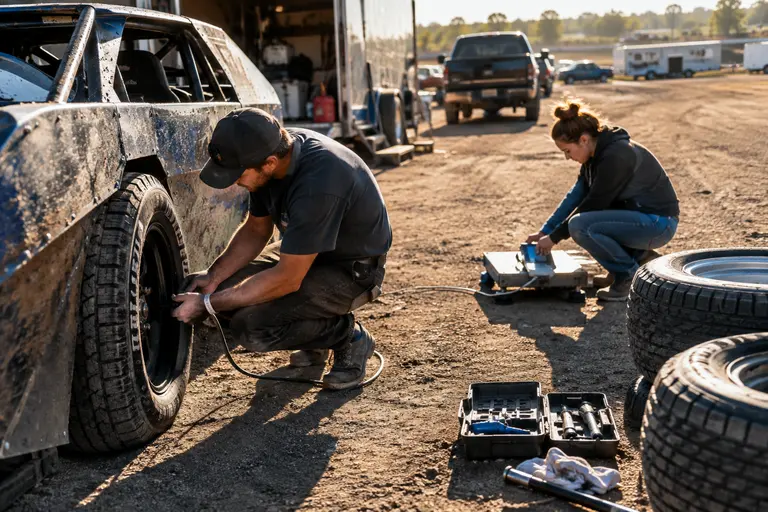
Good dirt teams write things down. For Texas Motor Speedway events, notes should include tire type, spoiler measurement, weight after fuel burn, harness condition, helmet certification, glove condition, and any inspection feedback. If a team hears a pit-area claim about a rule, the safe response is not to change the car on hearsay. The research notes say technical questions or legality issues were resolved with the Technical Inspector, and the Race Director announced how many cars would go through post-race technical inspection during the driver’s meeting.
That driver’s meeting matters. It is where the crew gets the day’s enforcement rhythm, and it gives racers a chance to align their equipment plan with track procedure. A calm driver who knows the car, suit, helmet, belts, ballast, and tires have been checked can spend more attention on driving.
Texas Motor Speedway Dirt Racing Gear Takeaways
What Racers Can Control After October 2026
The October 2-3, 2026 championship weekend is now in the past, but its equipment lesson still applies. Racers cannot control track draw, traffic, or how another team prepares. They can control the condition and organization of their dirt racing gear, the accuracy of their measurements, and the way their crew responds to inspection requirements.
Ballast is a good example. The research notes say Limited Modified ballast could not be mounted in the cockpit, outside the body or hood, or on the rear bumper. It had to be securely bolted with at least two 0.5-inch bolts, painted white, and clearly numbered. Those are concrete checks a crew can perform at home before loading. Waiting until the track adds pressure and invites mistakes.
A Practical Path For Families And Crews
The best preparation plan is simple enough for the whole crew to repeat. Assign one person to safety wear, one to tires, one to belts and seat area, and one to rule measurements. Keep a printed or digital checklist tied to the Texas Motor Speedway class and event. After each race day, record what passed, what needed attention, and what should be replaced before the next outing.
For racers, this is where equipment care supports confidence. Clean gloves, a certified helmet, a properly fitted fire suit, secure belts, legal ballast, and documented setup choices all help turn a busy race day into a controlled one. Texas Motor Speedway’s 2026 dirt programming showed how scheduling and rules can shape preparation. The racers who keep learning from that structure give themselves, their families, and their local racing community a stronger base for the next green flag.